

Introduction –
In my research report, I hope to answer the question of what makes the ideal crime story? Policing and criminology is something that really interests me, hence why I am pursuing it as a career and in this project. I think the basis of my interest in this topic stems from watching police programs on television from a young age. I would say that as a young person I looked up to police officers as I was always taught that they were good people. As I’ve got older I have continued to take an active interest in the police, especially what happens in the news and the stories behind it. I have taken an interest in American policing as well, as they do the job in a completely different way. Since joining a creative media course at college, I have been given the opportunity to write a lot of criminology related stories and informational materials. I have studied what makes a good crime story by looking at examples of industry standard work, and analysed them for my own benefit. I have also taken a step into the unknown by using the radio studio to create a criminology related podcast. This required me to do much research in order to get my facts right. I listened to a few podcasts to get an idea of what it should sound like and was quite pleased with my finished product.
What will be incorporated in my research report?
In this report I will begin by walking you through the processes I undertook in coming up with my hypothesis. I will explain why I chose this question and what benefit I think it will have to my wider project.
After this I will move onto the various forms of research I undertook in order to answer my question and gather more information on my topic. These include :
-My use of mind maps to decipher what it takes to make an ideal crime story. I used this method to break down my question into lots of smaller parts.
-My analysis of 3 industry examples which I have studied in great depth to see what other authors and film makes do to make a great story or possibly a not so great one.
-An interview with an ex police officer to give me insight into the thought process of a real life officer with first hand experience. This gave me access to the actual procedure behind modern policing.
All of my work will be formed into a structured form to allow for it to be easily read and understood. I will go into detail as to why I have chosen each of these research methods, and how they will help me form an intelligent answer to my question. Finally I will write my conclusion which will include the final answer to my hypothesis.
Methodology –
Primary Research:
To begin with I decided to analyse 3 industry examples which I thought could benefit me in helping answer my question. The beauty of having thousands of industry examples to chose from is that there are endless different styles of work to analyse and learn from. I believe that by simply choosing 3 of them I have expanded my knowledge exponentially and developed new ideas that I otherwise would not have thought of. Here are my 3 analytical reviews of different crime pieces –
The Big Sleep – Raymond Chandler
‘The Big Sleep’ is a crime/ detective novel written by Raymond Chandler. Set in a 1930’s Los Angeles, the novel is narrated by the main character Philip Marlowe. Marlowe is a private detective who has been hired to investigate a blackmail case relating to the death of a famous pornographer. His death has caused many other deaths. This is the first of two major conflicts throughout the novel. In the second half of the novel, the detective is concerned with the disappearance of another character. At the end of the novel, the detective is confronted by someone trying to kill him in an abandoned oil field. He uses this experience to put the pieces of the mystery together and solve the second major conflict. The main suspect is forced to confess and the mystery is solved. The entire novel is based around the theme of corruption and self-interest in 1930’s America. The novel is an example of a ‘hard-boiled’ detective novel. A ‘hard-boiled’ detective is someone that shows more masculine qualities than others. They can be compared to knights due to their motivation being personal honour and lack of respect for state justice. This is evident in the novel when Marlowe talks negatively about the police. According to online sources, “Often, critics compare the detective of hard-boiled fiction to a questing knight. Think of King Arthur’s knights, for example, who go on quests to find valuable objects (like the Holy Grail) or to slay a villain. The Holy Grail in hard-boiled fiction is usually the truth.” The story is told from the perspective of the main character, Philip Marlowe, who is a private detective. Chandler deliberately gets into the mindset of a detective when writing this piece so that he can portray a believable character. The way in which minor details are analysed throughout clearly shows the reader that the narrator, a detective, is actively trying to solve the case whilst they’re reading.
My sources :
SparkNotes: The Big Sleep: Key Facts. 2020. SparkNotes: The Big Sleep: Key Facts. [ONLINE] Available at: https://www.sparknotes.com/lit/bigsleep/facts/. [Accessed 05 March 2020].
Encyclopaedia Britannica. 2020. The Big Sleep | Introduction & Summary | Britannica. [ONLINE] Available at: https://www.britannica.com/topic/The-Big-Sleep-novel-by-Chandler. [Accessed 05 March 2020].
Study.com. 2020. The Big Sleep by Raymond Chandler: Summary & Analysis | Study.com. [ONLINE] Available at: https://study.com/academy/lesson/the-big-sleep-by-raymond-chandler-summary-analysis.htm [Accessed 06 March 2020].

Real Detective – Netflix Documentary (Ep 1)
Reliving the hunt for a serial murderer in Seattle, Washington in 1997, Real detective uses dramatic depictions of events to hook the viewer and reel them in to what they are watching. The narrator is the detective who worked the case and therefore is able to give the viewer inside information. The recreations are filmed using actors who seem to follow police procedure throughout, allowing the viewer to become immersed in what is going on in front of them. I believe that the narrator is the key to this being an effective documentary as we as viewers are able to respect his opinion a lot more in comparison to if it was just a random voice telling the story. The detective deliberately goes through the questions he was asking himself at the time, which gets the audience thinking. He doesn’t always answer the questions straight away which again hooks you and reels you in as you’re constantly thinking about what the answer to the question would be.
In terms of police procedure, the filming begins with the detective and other officers cordoning off the area in which the body has been found. The examine the body for obvious clues and make preliminary presumptions about what has happened. They then question potential witnesses at the scene before the footage cuts to the detective at the medical examiners office. Here, the medical officer reveals the name of the victim through the use of finger prints and they discuss how the person died and what injuries were caused. The next step of the journey takes us to see the victims grieving family. The detective and his partner question the boyfriend and mother of the victim to try and establish some clues, and to try and see if either of them might have been involved. The detective tells us “I think my partner and I developed a relationship with Denice (The victim)”, which I think is very interesting. Through investigating every aspect of this woman’s life, they have got to know her almost as well as if she were still alive. I think this is lacking in many fictional crime stories in which the detective is commonly very detached from the victim. One of my favourite parts about this program is that it constantly takes us back to the detectives office and shows the discussions between the him and his partner. It shows that he is not alone in solving this case and relies on the ideas and theories of others to help him.
Finally, the prison interview in which the detective finds out who the killer is absolutely perfect. The person who plays the criminal gives off the perfect vibe of a shifty individual who knows more than he lets on. The acting throughout is great and puts us very much in the moment that this is all happening. The ending is shocking and we finally get to answer the questions that the detective was asking himself from the beginning.
When it comes to writing my own pieces I definitely think I will use aspects of this documentary in my writing. I like the fact that the detective works closely with a partner who he can bounce ideas off of, therefore not making himself seem like the sole hero. I think I will also use a scene like the one where he is visiting someone who is already locked in prison. The mental battle between the detective and the criminal trying to play each other is fascinating as it is completely unpredictable and makes the viewer want to keep watching in order to see who comes out on top.
Real Crime – Diamond Geezers (2008) – Tom Whitter
“In an attempted heist worthy of a Hollywood film, a cadre of criminals sets out to steal the worlds largest perfect diamond from a London landmark”.
Based on a real event that made headlines around the world, this documentary uses exclusive police footage and dramatic reconstructions to tell the story of one of the worlds largest attempted heists. Along with a primary narrator who tells us what is going on throughout, this program makes great use of eye witness statements and interviews to give us inside knowledge of what really happened. The chief officer in charge of the police operation is one of the most informative witnesses used. He tells us all about how they caught wind of what was happening and demonstrates some of the police procedure used at the time. This information all contributes towards one key factor. Trust. When a viewer trusts the reliability of the sources used in a production then they are far more likely to read or watch on. For someone like myself who wants to know that what I’m watching is realistic and minimally staged, it is great to see.
There are many aspects of this documentary that I may add to my writing, The use of the police planning board in which they are putting pins in order to try and plan where the next robbery may be is a great scene. I think that I could use this to create a great image for my readers in which my character and his partner are trying to solve a case. It would really put my audience in the room with the detective and they could try and solve the problem at the same time.
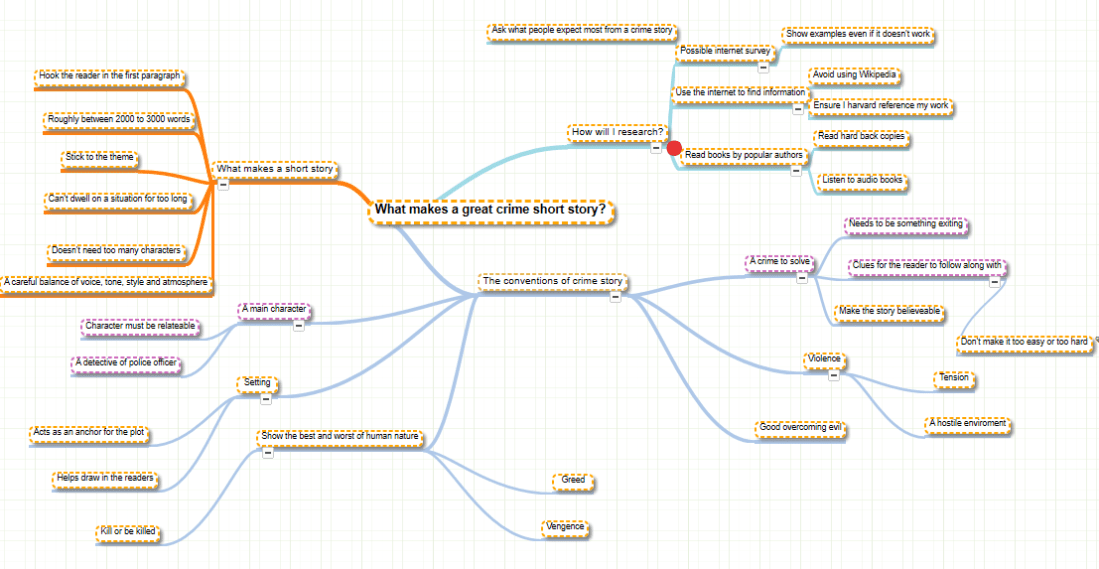
Interview with an ex-police officer –
As one of my research methods I chose to send out some questions to an ex police officer. I believe that interviews are a very important form of research as they allow me to get inside the mind of an actual person who has experience in the field of what I am going to write about. Here is what he said –
As an ex police officer, would you say your career was as action filled as books and television series make it out to be?
“In the last half of my career yes I would. This is because I was an Armed Police Officer on the Kent Police Armed Response Unit.”
Walk me through a typical case, how is it solved and who is involved in doing so?
“Depending on the severity of the case, generally you would have an initial response from the patrol officers. If an offender gets arrested then they would be taken into custody where they would be dealt with by a Custody Sergeant. Whilst there they will have their fingerprints and DNA.
They would then be interviewed, possibly by a Detective. If there is any types of forensic evidence, the then the CSI would be involved.
If they are charged they will then be charged and given a court date. If the offence is serious the offender may wait in custody and have to be taken straight to court. This is done by an independent company called Serco.
Once at court, they will be delivered to the cells where they will be handed to the court custody staff.
They will then be taken into court and put before a Judge or Magistrate.
A lot of this will be determined by the severity of the crime that has been committed.”
Do you think the public would find how a crime is actually solved interesting, or do the more action filled interpretations do a better job?
“I think that the public would prefer the action filled interpretations.”
What is the most interesting crime you have ever been involved in?
“The most interesting crime(s) I have been involved with have been shootings and County or National organised crime.”
Do you think the media portray the police in a fair way?
“No not really. I think that the Police are given a bad reputation.”
Do you watch or read any particular crime series that you think are realistic?
“I do like to watch true crime documentaries on the television.”
From the questions I have asked, I feel I have gained some insight into the mind of a police officer. This will come in use when I am writing my final pieces as I can use the information I have learned to make my characters and scenes more realistic. Being taken through the process of a typical case is very useful as I feel it will add realism to my story. The element of police procedure will enhance my writing, and hopefully be a benefit to my readers.
Previous work for a crime podcast –
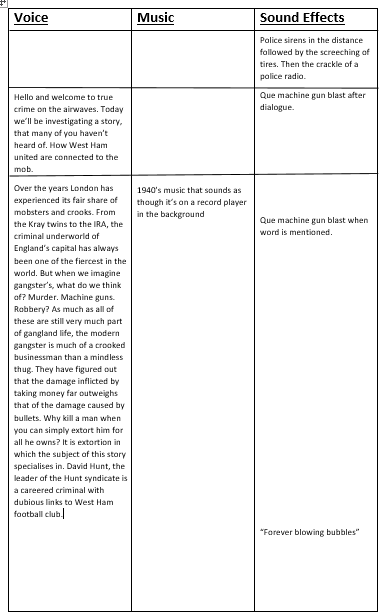
Above is an extract from my script which I wrote for a crime podcast. I researched the subject of this podcast online using a variety of different websites in order to build up an understanding of who my subject was.
Findings –
Throughout this project I have aimed to answer my hypothesis which is “what makes the ideal crime story?” I believe that by doing my research I have uncovered a wealth of information that will help me to firstly answer this question, and secondly help me when I am creating my own crime stories. Through looking at a combination of fictional stories, documentaries and interviews I have been fascinated to discover that there are so many different ways I can set up a story. I have been particularly pleased with what I have learned about modern police procedure as it is something that I am interested in incorporating into my own work. Hearing all about it from a real police officer makes my information as accurate as it can possibly be which will really enhance the realism of my writing.
I also particulaly enjoyed the dialogue used in the making of the documanteries which I studied. The interaction between fellow police officers and the officers and criminals is something I would like to perfect when it comes to my own writing. I think getting to hear the tone which the actors spoke in gave me some great ideas for how my own characters will speak and interact. I will be able to expand on these ideas given to me by the dialogue, through the use of character studies in order to perfect my characters.
Looking back through my research, I have identified some key differences between older crime novels and modern police procedure. I think the lack of realism in past novels wouldn’t hold up in todays market where everyone has access to what the police actually do. From this discovery, I am now certain that my final piece will focus on police procedure in order to tap into todays market.
Conclusion-
From my research I believe that I have conclusive evidence as to what makes the ideal crime story. I have found that there are multiple ways of making great stories, all of which bring fantastic ideas to the table. From the documentaries that I have analysed, I became obvious to me the importance of police procedure in more modern crime stories. In the world we live in now, information is so easy to come by and people expect what they are reading to be factually correct. I will use this information I have found to influence my own writing as I will try to add in all of the core aspects of police procedure. My knowledge of this was further reinforced through my interview with a former police officer. His first hand experience of how a case is solved has given me new ideas on how my character will use the rest of his team to help solve the crime. Continuing on the aspect of team work, my research made it obvious to me that a lot of the older crime novels were written with a distinct lack of it in mind. “Old generation” detectives such as the one in “The Big Sleep”, were far more solo participants in their mysteries and played a more “knight in shining armour” role in the story. Although I have decided this is not a route I wish to take in my work, it was still useful research to partake in as I have taken some inspiration from the detectives personality within the book. I like his somewhat emotionally damaged personality as I think it plays an underlying role in how he goes about his work. It is very much something that I would like to apply to my own character, as I think that an internal conflict would make for some interesting twists and turns in my own writing.
From my overall research I think there are a variety of strengths and weaknesses. One of the first major strengths that I would point out is the level of detail to which I have analysed my 3 industry examples of work. I meticulously worked through each piece in order to see how it would help me with my own work and what aspects of each I would like to avoid. I also think that the combination of documentaries and novel has given me a wider understanding of the crime genre. Not only have I been able to read how another author structures and crafts his own ideal crime story, I have also been able to watch how police officers go about their job. All of this I feel will culminate in more well rounded piece of writing that takes aspects of both mediums into consideration. I would also like to point out the strength of having an interview as part of my research. I think that it is all well and good taking information from the internet, but hearing from someone with first hand experience really puts the job into perspective. How the police officer described solving a case has given me a lot of inspiration as to how my own character will attempt to do the same.
Continuing on the subject of my interview, I must bring up one of the negative aspects of my research. Whilst the answers I received from my source were satisfactory, I cant help but think he could have gone into more detail on some of the questions I asked. A few of them were somewhat vague answers which I could not gather much information from. In the future I would ideally ask the same questions to a few more police officers if I could find them. This would give me a wider pool of information to work with, and maybe give me a few more ideas to develop. Another small downfall of my research was the lack of information I could find about the previous bit of crime research I had done. Some time ago, I created a podcast on David Hunt and did a lot of research to see what he did and what sort of person he was. I think this research would have been another great example to add to my portfolio of research, however I seem to have misplaced this work. Finally, I did attempt to make a questioner to see what other people thought made the ideal crime story. I posted it onto quiz monkey and have currently got not replies. This would have been good information to have as it would have enabled me to further tailor my work towards what my audience wants. If I were to do it again, I would try and put my quiz out on a platform with a wider audience in order to gather more information.
 ArchieHall Journalism
ideal crime story
ideal fictional crime story
You could add to the introduction the family ties to the services – I am sure this has been a contribution to your feelings and ideas towards the police and other services.
Also add to the introduction the further development of the knowledge you gained in our sessions and our conversations (call it an interview with me about London Crime syndicates that got yo started). Plus last years sessions on Genre and Tone where we used Crime to demonstrates how a writer sets a tone and what the reader expects to see in a crime story (conventions and tropes).
You had a series of sub-questions as well. You can use them at the beginning and then in the Findings tell the reader how you answered these questions, or didn’t manage to answer the question.
Intro is very good other than that.
therefore not making himself seem like the sole hero.
You could give examples of how this is used in fiction. There is a long history of detectives and their side-kicks: the obvious one is Sherlock Holmes and Dr Watson, and Hercule Poirot and his partner Captain Hastings, plus Morse and Lewis… the list is endless.
Of course the Martin Beck series is different in that it is the first police procedural novels and there is an ensemble cast on different cases or some taking the lead in different stories. Would have been great to have read or watched a few of these: there are ten in the series plus a great adaptation on BBC4.
Methodologies
This is strong – very good analysis and an interview with a policeman are effective research sources. I would like to see just a bit more. You could add other sources you have looked at from unit 9. No need to go into so much depth but I think you would agree that a lot of the sources you looked at there will feed into you writing. You can name them in the methodologies and the tell me what you got in the Findings.
Also, you could just add numerous links to websites that analyse and demonstrate the genre conventions e.g. https://www.slideshare.net/imogenmarsden/conventions-of-crime-films
Easy to add and look through and then say how the will impact on your own writing.
I will also send you a few links to other extracts and short stories that might help with tone, style of writing and characterisation.
Findings:
You need to be specific here: it may be that you are repeating yourself, but the Findings is about expressing what the most important and relevant aspects of the methodologies were. For instance you will have one story with a detective and his partner.
It can be a big or small inspiration or influence or insight – but it is in the Finding where you write about them and their relevance.
The strengths and weaknesses of each piece of research.
Here you can say that Chandler helped you think about word choices and the literary and narrative techniques he uses such as imager and foreshadowing. With the docs you can mention how the may impact in your set-up, the inciting incidents: the structure, the opening how we are introduced to characters etc.
This is the end of detail.
Use some of your questions as subheading perhaps to demonstrates that they have or haven’t been answered.
You then add a short discussion at the end which is a summary: here you can tell the reader wether you have answered your questions or questions.
Has the research been a success on the whole or would you have liked to have done further research? Was the research strong or were there weaknesses?
So, good so far, but needs more sources mentioned in Methodologies and detail in the Findings section and then a final Discussion. My comments probably look like you have lots to do, but you should be able to add much of the above from previous work and sessions and feedback and comments from me. Let me know if this all okay.
I’l also email the feedback.
LikeLike
There are some excellent aspects to the research – it is a shame you couldn’t get more primary but there is enough and you at least show your intent – plus the analysis of the industry examples is very good. It would have benefited the whole project if you could have explored other avenues of research other than those that I helped you with – this is mostly because you need to gain confidence in independent learning ready for uni and your career.
On the whole it is skilfully and eloquently written.
There is sufficient relevant information gathered, documented and used in the development of your ideas.
You will, going forward to Uni next year need to develop your skill in how to structure arguments in essays and research reports and above all read feedback and keep focussed and motivated.
Move on now and get as much of the portfolio and your story done asap.
LikeLike